
The fear of getting nickel-and-dimed in 2026 looms large for many online merchants. While the $39/month base fee may seem harmless, hidden costs like app bloat and transaction fees can quietly erode profit margins. This guide aims to provide a raw, developer-level breakdown of the true cost of ownership.
With over 6.8 million active stores worldwide, Shopify presents a mature platform with extensive operational data. However, it’s essential to distinguish between the $5 Starter option and full store plans that can soar to approximately $2,300 or more per month. We will analyze Shopify’s features, including SSL certificates, PCI compliance, and hosting, against the technical limitations developers face during migration and customization.
Ultimately, this analysis will answer the question of whether Shopify’s recurring investment makes sense for U.S. DTC merchants generating $10,000 to $250,000 or more in monthly revenue.
Key Takeaways
- Understand the real costs of running an online store on Shopify.
- Evaluate the differences between Shopify’s pricing tiers.
- Learn about hidden fees that can impact profit margins.
- Assess the platform’s features against developer challenges.
- Determine if the investment aligns with your business revenue goals.
Pros and Cons of Shopify (From a Developer’s Perspective)
Navigating the intricacies of Shopify can be daunting for many online merchants. Key limitations exist that impact SEO and overall flexibility. Understanding these challenges is crucial for optimizing your store.
Core URL Slug Limitations and SEO Impact
Shopify’s fixed /products/ and /collections/ URL structures create migration issues. This can lead to canonicalization problems, especially for established blogs with existing SEO equity. Adjusting these slugs is not an option, which can stifle organic growth.
Liquid Coding Barriers and Multi-Currency Limitations
Shopify uses the Liquid template language for advanced theme customization. While this offers control, merchants without coding experience may struggle. Simple design changes can consume valuable time.
Checkout customization is limited to colors and fonts unless you opt for Shopify Plus. Additionally, while the platform supports international commerce in up to three markets, native multi-currency payouts remain restricted without an upgrade.
- Fixed URL structures complicate SEO efforts.
- Liquid coding can slow down implementation for non-coders.
- Checkout options are limited for non-Plus users.
- Multi-currency support is not available without an upgrade.
Is Shopify Still Worth It in 2026? (The True Cost of Apps)
Merchants often overlook how quickly costs can escalate with added tools and features. The $39 monthly Basic plan may seem manageable, but the reality is stark. After incorporating review software, pop-ups, email tools, and other paid apps, your monthly expenses can soar to between $150 and $300.
Shopify apps typically range from $5 to $100 each. If you opt for just five modest tools, you’re looking at an additional $25 to $500 in costs. With over 20,000 apps available, the risk of duplicating functionalities increases, leading to more support tickets and ongoing fees.
Moreover, merchants using the Basic plan face a 2% surcharge on all sales if they choose not to use Shopify Payments. This penalty directly impacts profit margins before even considering card-processing fees. Additionally, currency conversion fees of 1.5% for U.S. transactions further complicate international sales.
Is Shopify Plus Worth It? (When to Upgrade)
The choice to upgrade to Shopify Plus hinges on specific operational requirements. For many merchants, this decision is not merely cosmetic; it’s about overcoming real constraints that can impact revenue.
One major trigger for considering Shopify Plus is the 100-variant limit. If your catalog exceeds this, it can restrict product architecture and hinder merchandising efforts.
Another critical factor is the need for B2B wholesale automation. This is especially relevant for businesses requiring negotiated pricing or tailored payment terms for their buyers.
Additionally, access to the Script Editor allows for advanced checkout customization. This feature enables merchants to automate discounts and payment rules, optimizing high-volume transactions.
With Shopify Plus starting at approximately $2,500 per month, it can be a justified investment for businesses needing flexibility and advanced features.
Detailed Breakdown: The True Cost of Shopify: 2026 Breakdown
Understanding the financial implications of operating on this platform in 2026 is crucial for online merchants. Evaluating various plans helps in making informed decisions about which tier suits your business needs.
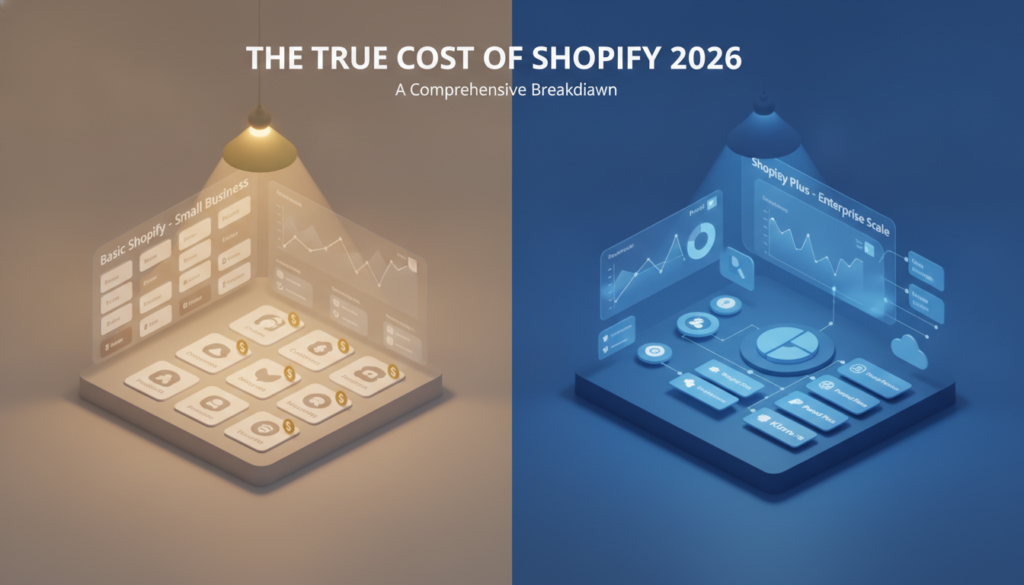
Below is a comparison table that outlines the costs associated with different plans, including base prices, average monthly app costs, and credit card rates.
| Plan Tier | Base Price | Average Monthly App Costs | Credit Card Rates | Best For |
|---|---|---|---|---|
| Shopify Starter | $5/month | N/A | N/A | No standalone online store |
| Shopify Basic | $39/month or $29/month (billed annually) | $25-$100 | 2% | Independent sellers |
| Shopify Grow | $105/month or $79/month (billed annually) | $50-$150 | 1% | Growing businesses |
| Shopify Advanced | $399/month or $299/month (billed annually) | $75-$200 | 0.6% | Established brands |
| Shopify Plus | From $2,300/month | $100-$500 | Custom rates | Large enterprises |
Each tier has its unique pricing structure and features. Premium themes can add an additional $100 to $500 before app subscriptions. Understanding these costs helps in aligning your business strategy with your financial goals.
Design and Customization: Shopify Themes and Editing Flexibility
The balance between user-friendly themes and advanced customization can impact your store’s success. Shopify provides a variety of options that cater to both novice and experienced merchants.
For those just starting, Shopify offers 13 free themes. This allows new merchants to launch their stores without an immediate investment in premium themes, which can range from $100 to $500. The theme editor is intuitive, enabling users to adjust colors, fonts, and layouts without any coding knowledge.
However, advanced customization may require knowledge of Liquid, Shopify’s coding language. Merchants looking for custom templates or unique product experiences will encounter this necessity. Premium themes can enhance merchandising but do not eliminate all customization constraints.
Evaluating design flexibility against factors like conversion rates, mobile performance, and accessibility is crucial. Here’s a summary of the key aspects:
- Shopify’s free themes provide a solid starting point.
- The theme editor allows easy adjustments without code.
- Advanced customization may require Liquid knowledge.
- Premium themes can improve design but come with limitations.
- Flexibility must align with business goals and customer experience.
| Theme Type | Cost | Customization Level | Ideal For |
|---|---|---|---|
| Free Themes | $0 | Basic | New merchants |
| Premium Themes | $100-$500 | Advanced | Established brands |
| Custom Themes | Varies | Full | High-volume stores |
Multi-Channel and Omnichannel Selling with Shopify
For many merchants, the ability to sell across multiple channels can be a game-changer. Shopify excels in integrating various platforms, enabling businesses to reach customers wherever they are. This includes social media giants and popular marketplaces.
Shopify connects catalogs to platforms like Facebook, Instagram, Pinterest, TikTok, Amazon, eBay, Etsy, Walmart, and Google Shopping. These integrations streamline marketing efforts and enhance visibility for your products.
With Shopify Marketplace Connect, merchants can synchronize listings, orders, and inventory across Amazon, eBay, and Etsy. This central management feature simplifies operations and improves efficiency.
Additionally, Shopify POS links online and offline payments, inventory, and customer data. This integration supports a consistent customer experience across various selling environments, whether in-store or online.
Social selling reduces checkout friction, but merchants must maintain accurate product feeds and manage inventory effectively. Printful and other print-on-demand integrations allow testing of products without upfront inventory costs, although fulfillment speed remains a critical factor.

- Connect catalogs to multiple social platforms.
- Synchronize inventory across various marketplaces.
- Manage online and offline sales seamlessly.
- Utilize print-on-demand services for flexibility.
- Ensure disciplined inventory management for success.
SEO and Content Management on Shopify
Shopify offers essential SEO features, yet it also presents unique content management hurdles. Merchants can edit meta titles and descriptions, which are crucial for optimizing products, collections, and pages. These controls empower businesses to enhance their visibility in search engines effectively.
Shopify’s reports provide valuable insights into marketing performance, user behavior, and site speed. This data helps teams identify areas for SEO improvement and conversion optimization. However, the platform falls short in advanced editorial workflows, especially when compared to WordPress.
Content limitations arise from Shopify’s fixed URL paths, which complicate migration and SEO efforts. Merchants aiming for a robust content strategy may find the long-form publishing tools lacking. To extend their SEO capabilities, many turn to third-party apps for structured data and keyword tracking.
- Meta title and description editing enhances on-page SEO.
- Shopify reports provide actionable marketing insights.
- Limited long-form content tools compared to competitors.
- Fixed URL paths complicate SEO and migration.
- Third-party apps can enhance technical SEO capabilities.
Exploring Shopify Payments and Transaction Structures
Understanding the payment structures on Shopify can significantly impact your bottom line. Each plan has unique transaction fees that can affect your overall profitability.
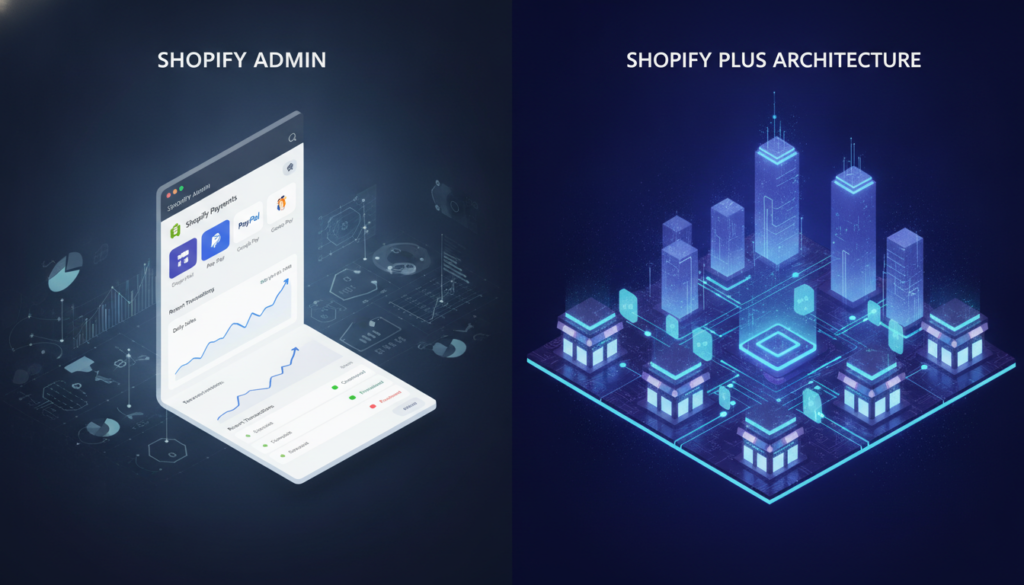
The Basic plan imposes a 2% surcharge for using third-party gateways. The Grow plan has a 1% surcharge, while the Advanced plan charges only 0.6%. This means that your choice of payment method directly influences your contribution margin.
Using Shopify Payments can be advantageous. It eliminates the third-party gateway surcharge, keeping all payment data centralized within the platform. Card rates start at 3.9% per transaction, but these rates can vary based on the country and card type.
Shopify Payments is available in major markets, including the United States and most European Union countries. However, unsupported regions may require alternative gateways. When evaluating payment options, consider effective costs based on order value, refund frequency, and chargebacks.
- Basic applies a 2% third-party gateway surcharge, Grow applies 1%, and Advanced applies 0.6%.
- Shopify Payments card rates begin at 3.9% per transaction.
- Using Shopify Payments avoids separate surcharges and centralizes data.
- Shopify Payments is available in major markets, but unsupported regions require alternatives.
- Evaluate effective payment costs based on various factors.
Real-World Merchant Experiences and Case Studies
Examining actual merchant experiences sheds light on the platform’s capabilities. Many successful brands showcase the potential of this e-commerce solution. Notable examples include Gymshark, Allbirds, Kylie Cosmetics, and Fashion Nova, which demonstrate that this platform can support recognizable brands across various sectors.
For instance, Subtle Asian Treats generated an impressive $19,000 in just two months selling bubble tea plush toys. This success illustrates how focused products and targeted marketing can validate a store quickly.
Shopify’s partner ecosystem is robust, with over 100,000 partners across 50 countries. This network provides merchants access to developers, migration specialists, and consultants, enhancing their operational efficiency.
Moreover, 24/7 support through live chat and email reduces operational downtime for merchants lacking internal resources. While these examples showcase the platform’s capabilities, they do not guarantee profitability. Factors like acquisition costs, product-market fit, and customer retention ultimately determine commercial success.
is shopify worth it?
Assessing the true value of Shopify for different business models requires a detailed analysis. Each business type has unique needs that affect the decision to use this platform.
For DTC merchants, Shopify provides fast deployment and centralized operations. This setup supports future sales growth, making it a solid choice for physical-product businesses.
Dropshipping and print-on-demand sellers benefit from low inventory exposure. Integrations with services like Printful and DSers simplify scaling operations.
However, digital-only sellers may find Shopify less cost-efficient than alternatives like Gumroad or Payhip. The monthly subscription and app costs can add up quickly.
For those already using WooCommerce, transitioning to Shopify may not be necessary. WooCommerce can operate below $39 monthly, but it requires more management of hosting and security.
Additionally, platforms like BigCommerce start at $29 monthly without transaction fees. Meanwhile, Wix and Squarespace offer stronger visual options for businesses that do not need Shopify’s robust sales infrastructure.
| Business Model | Shopify | WooCommerce | BigCommerce | Wix/Squarespace |
|---|---|---|---|---|
| DTC Merchants | Ideal for fast deployment | Requires more management | Starts at $29/month | Visual flexibility |
| Dropshipping | Low inventory risk | Higher management overhead | No transaction fees | Limited sales tools |
| Digital Products | Higher costs | More control | N/A | More cost-effective |
Impact of Third-Party Apps on Store Performance
The extensive range of third-party apps available can be both a boon and a burden for online merchants. While these tools can enhance functionality, they also introduce risks that can affect performance and costs.
Shopify does not limit the number of apps a store can install. However, every additional script, webhook, and integration increases operational risk. As of mid-2026, there are over 20,000 apps available, making it essential for merchants to evaluate their choices carefully.
Balancing Essential Tools with Overall Costs
Merchants should establish a documented evaluation process based on:
- Incremental revenue generated by each app.
- Impact on online store speed and performance.
- Quality of support provided by the app developers.
- Ownership of data generated through app usage.
Apps costing between $5 and $100 each can lead to a fragmented tech stack. This can result in overlapping functionalities, such as review, email, and analytics tools, which may dilute effectiveness.
To maintain optimal performance, teams should:
- Audit unused apps regularly.
- Remove duplicate scripts to streamline operations.
- Test checkout and theme performance.
- Compare app-generated revenue against recurring monthly costs.
Shopify’s built-in reports include online store speed data, which can support performance reviews. Additionally, technical audits should measure Core Web Vitals, JavaScript execution, and mobile conversion rates to ensure a seamless customer experience.
Shopify’s Scalability and Long-Term Growth Potential
The ability of a platform to scale effectively can determine the long-term success of an online store. Shopify can support more than 100,000 products for most stores. In fact, some exceptionally large Shopify stores exceed 2 million products without needing routine migration.
For brands generating under $4 million to $5 million in monthly sales, Shopify remains a viable option. The hosted infrastructure, built-in CDN, SSL, and PCI compliance significantly reduce maintenance burdens during traffic spikes and seasonal campaigns.
Shopify Plus enhances operational capacity, allowing up to 200 inventory locations and unlimited staff accounts. This flexibility supports enterprise fulfillment and distributed teams effectively.
However, scalability does not eliminate challenges. Merchandising, SEO, shipping, and app performance constraints remain. Growth audits must examine the entire commerce system rather than focusing solely on traffic.
- Shopify can support more than 100,000 products, with some stores exceeding 2 million.
- Managed updates and built-in CDN ease maintenance during peak traffic.
- Brands under $4 million to $5 million in monthly sales can operate effectively.
- Shopify Plus offers up to 200 inventory locations and unlimited staff accounts.
- Scalability does not remove constraints; comprehensive audits are necessary.
Conclusion
Evaluating the impact of recurring costs and operational complexities can clarify the decision for many merchants. Shopify remains a strong choice for those valuing reliable hosting, rapid deployment, and multichannel selling. However, as app subscriptions and fees accumulate, it can diminish profitability.
Merchants should conduct a thorough audit of URL structures, app dependencies, and payment options before committing. If operational friction arises from limits on variants or checkout automation, Shopify Plus may offer necessary solutions.
Ultimately, consider whether the platform’s managed infrastructure and sales tools can save more time and revenue than the recurring costs create. This pragmatic approach will help in making an informed decision.
Pingback: How Healthy Is Your Ecommerce Returning Customer Rate? Benchmarks, Formulas & Proven Fixes
Pingback: How to Set Up Shipping Rates on Shopify ? (The Complete Guide)